Mold After Water Damage: What Grows, When, and Why the Clock Matters
Every mold problem that follows a leak or a flood starts as a water problem on a timer. Mold after water damage is decided in the first two days: materials that dry fast usually stay clean, and materials that stay wet grow. This guide explains the timeline, the materials that grow first, how to tell a truly dry structure from a dry looking one, and the point where drying stops being enough and remediation takes over. It covers the mold side only, and points you to inspection and testing when you need facts about your own house.
- The 24 to 48 hour window, explained plainly
- Moisture readings over guesswork
- Signs to watch in the weeks after
- Independent local providers
Why the first 48 hours decide the outcome
Mold can start growing on wet drywall, carpet pad and insulation within 24 to 48 hours of a leak or flood. Materials dried inside that window usually escape growth; materials that stayed wet become a remediation job. The difference is measured with a moisture meter, not judged by touch.
Mold needs three things: spores, food and moisture. Spores are already everywhere, in every Nashville home, all the time, and no cleaning changes that. Food is built into the house itself: the paper facing on drywall, wood, carpet pad and insulation are all on the menu. Moisture is the only one of the three a homeowner controls, and it is the one a leak hands over in unlimited quantity. That is why the mold question after any water event is not really about mold at all. It is about how long the materials stayed wet.
Nashville loads the dice. Summer humidity slows every drying effort, the clay soil keeps crawl spaces and slabs damp long after a flood recedes, and the rain pattern, about 49 inches a year, often arrives in bursts that find the same roof and foundation weaknesses repeatedly. A leak that would be a footnote in a dry climate becomes a growth event here if it is left to dry on its own schedule.
Mold after water damage, day by day
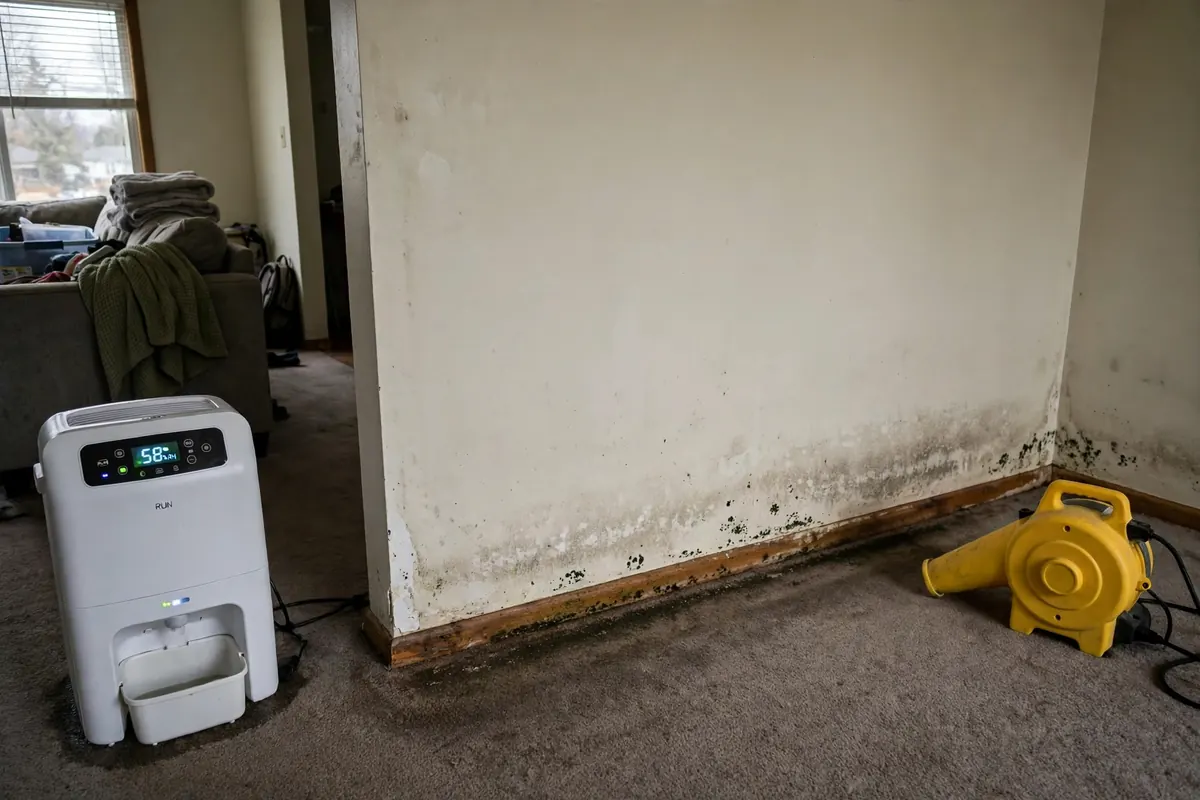
In the first 24 to 48 hours, spores on a wet surface germinate and begin feeding. There is nothing to see yet, which is exactly why this window is the whole game: dry the materials now and the story ends. Across days three to seven, colonies establish inside the material, in the drywall core, the pad under the carpet, the insulation inside the wall, still mostly invisible from the room. Into the second week and beyond, growth reaches surfaces and announces itself: a musty smell when the room is closed, staining at the baseboard line, paint beginning to bubble. By the time mold is easy to see, it has usually been growing for a while.
Two qualifications keep this honest. Clean water and dirty water are different events, and water that has passed through soil or a drain carries contamination that changes the response entirely; this guide is about the mold timeline, and contaminated water calls for professional help on the water side first. And the timeline runs at different speeds in different materials, which is the subject of the next section: a tile floor shrugs off a week of damp that would ruin the drywall beside it.
Which materials grow mold, and which resist it
Mold grows fastest where food and water meet in a porous material that dries slowly. The paper facing of drywall is close to a perfect food, and the gypsum core holds water, so wet drywall is usually the first casualty of any leak. Carpet pad behaves like a sponge laid flat: it takes water fast, releases it slowly, and sits hidden under the carpet while it grows. Insulation inside a wet wall stays damp long after the room side feels dry, and particleboard, in subfloors, cabinets and flat pack furniture, swells and feeds growth as it comes apart.
The resistant list is just as useful to know, because it tells you where a fast cleanup genuinely works. Concrete, tile and grout on a sound bed, metal, glass and sealed stone do not feed mold and clean fully; growth found on them is living on surface dirt, not on the material. Solid wood sits between the lists: framing dries reasonably and cleans well, which is why remediation removes the drywall and keeps the studs.
- Grows first. Drywall paper and core, carpet pad, wall insulation, particleboard and cardboard stored against a wet floor. Porous, food rich and slow to dry.
- Grows if given time. Solid wood framing, plywood subfloors, fabric and upholstery that stayed damp. Cleanable when caught, questionable when soaked for weeks.
- Resists. Concrete, tile, metal, glass and sealed stone. These do not feed mold; growth on them wipes off with the dirt it was living on.
- The decider. Drying time, not material alone. Even the resistant list grows a surface film if it stays wet and dirty long enough.
Dry to the touch is not dry
The most expensive sentence after a leak is "it feels dry." Surfaces dry first; the water that matters is the water inside the wall cavity, under the flooring and in the bottom of the drywall, and none of that reports to your fingertips. A structure is dry when a moisture meter says the materials are back at normal readings, measured at the same points that were wet, ideally more than once. That measurement is the whole difference between drying and drying theater. Fans left running for a weekend move air across the face of a wall whose inside can stay wet for weeks, growing the entire time. If nobody put a meter on it, nobody knows it dried, whatever the room smells like.
Signs in the days and weeks after
The early signs are modest. A musty smell that is strongest when the house has been closed up. Paint bubbling or peeling low on a wall that got wet. Baseboards staining, swelling or pulling away from the wall. Flooring that cups, gaps or feels soft near the wet area. White or dark fuzz on stored items and on the back of furniture against the affected wall. Any one of these in the month after a leak means the drying story and the real story have parted company, and the gap is where the mold is.
When drying was not enough, the next step is remediation, and it is a mold job, not a second round of fans. A mold inspection with moisture readings maps where the growth is and how far it traveled; then mold removal takes out the materials that grew through, cleans the framing and hard surfaces, and verifies the structure is dry before anything is closed up again. Where the facts are disputed, a sale, a rental, an insurance claim, mold testing puts the species and the spore count on paper. One boundary is worth stating plainly: drying, extraction and water restoration are a separate trade. This site deals with the mold that water leaves behind, and connects you with independent local mold providers for inspection, testing and removal.
Insurance follows the same timeline logic. Mold from a sudden, covered water event, reported when it happened, may be paid up to the mold sub-limit in the policy, which commonly runs from $1,000 to $10,000 per occurrence. Mold from a slow leak that ran for months is usually read as gradual damage and denied. Photograph everything on the first day, keep the readings, and report the water event when it happens rather than when the growth appears.
Common questions after a leak or flood
How fast does mold grow after a leak?
On wet drywall, carpet pad and insulation, growth can begin within 24 to 48 hours of the water arriving, and it keeps spreading as long as the material stays wet. That window is why drying speed matters more than any other factor after a leak. Materials dried inside the first two days usually escape growth entirely. Materials that stayed damp for a week should be treated as grown until an inspection says otherwise, because by then the colony is often inside the material where a surface look cannot rule it out.
Is a small leak really a mold risk?
Yes, and small leaks are often the worst kind. A burst pipe announces itself and gets dried; a pinhole drip under a sink or behind a washer wets the same square foot quietly for months, which is ideal growing time. Most of the mold found in Nashville homes traces to exactly this pattern rather than to floods: a slow supply line, a failing drain, a toilet that seeped at the base. Any leak that has wet drywall, subfloor or insulation for more than a couple of days deserves a moisture check, however minor it looked.
Does insurance cover mold after water damage?
Sometimes, and the deciding fact is how the water arrived. Mold that follows a covered sudden event, a burst pipe or a failed water heater reported promptly, may be paid up to the mold sub-limit in the policy, which commonly runs from $1,000 to $10,000 per occurrence whatever the real bill is. Mold from slow leaks, seepage or humidity is usually denied as gradual damage. Two habits protect a claim: report the water event when it happens rather than when the mold appears, and keep photographs and moisture readings from the first day.
Can I dry it myself with fans?
For a small spill of clean water on hard surfaces, caught the same day, fans and a household dehumidifier can be enough. The limits are real, though. Fans move air across surfaces; they cannot pull water out of a carpet pad, a wall cavity or wet insulation at the speed the 48 hour window demands, and touch cannot tell you whether those hidden layers dried. If drywall, flooring or insulation got wet, the honest test is a moisture meter reading, yours or an inspector's, before the wall is closed or the floor is laid back down.
When should I get mold testing after water damage?
Testing earns its cost in a few situations: when a musty smell persists but no growth is visible, when you need to know whether a hidden cavity is affected before opening or closing a wall, when a home sale or a landlord dispute needs results on paper, and as clearance after remediation to confirm the work. A straightforward case of visible growth on known wet material often does not need a lab to justify removal; the scope is the same either way. Testing should be independent of the company doing the removal, so the result is not graded by the seller.
The water is gone and there is no smell. Are we in the clear?
Not necessarily. Smell is a late sign, and the cavities where mold grows first, inside walls, under flooring, inside the pad, vent nothing to the room until the growth is established. The better test is the timeline and the readings: if porous materials stayed wet beyond about 48 hours, or if you never confirmed the hidden layers dried, an inspection with a moisture meter is cheap certainty. Rooms pass that check quickly when drying was real, and catching the exception early is the difference between a cleaning and a removal.
Water happened, and now the smell is starting?
That smell is the timeline telling you where you are. Reach out now to connect with a local provider who will put a meter on the wall and tell you whether you are looking at a cleaning or a removal. Start from the mold remediation Nashville homepage for the full service, or read how remediation is priced in our mold remediation cost guide.
Get Help Now